
 Call for free estimate and shop at home


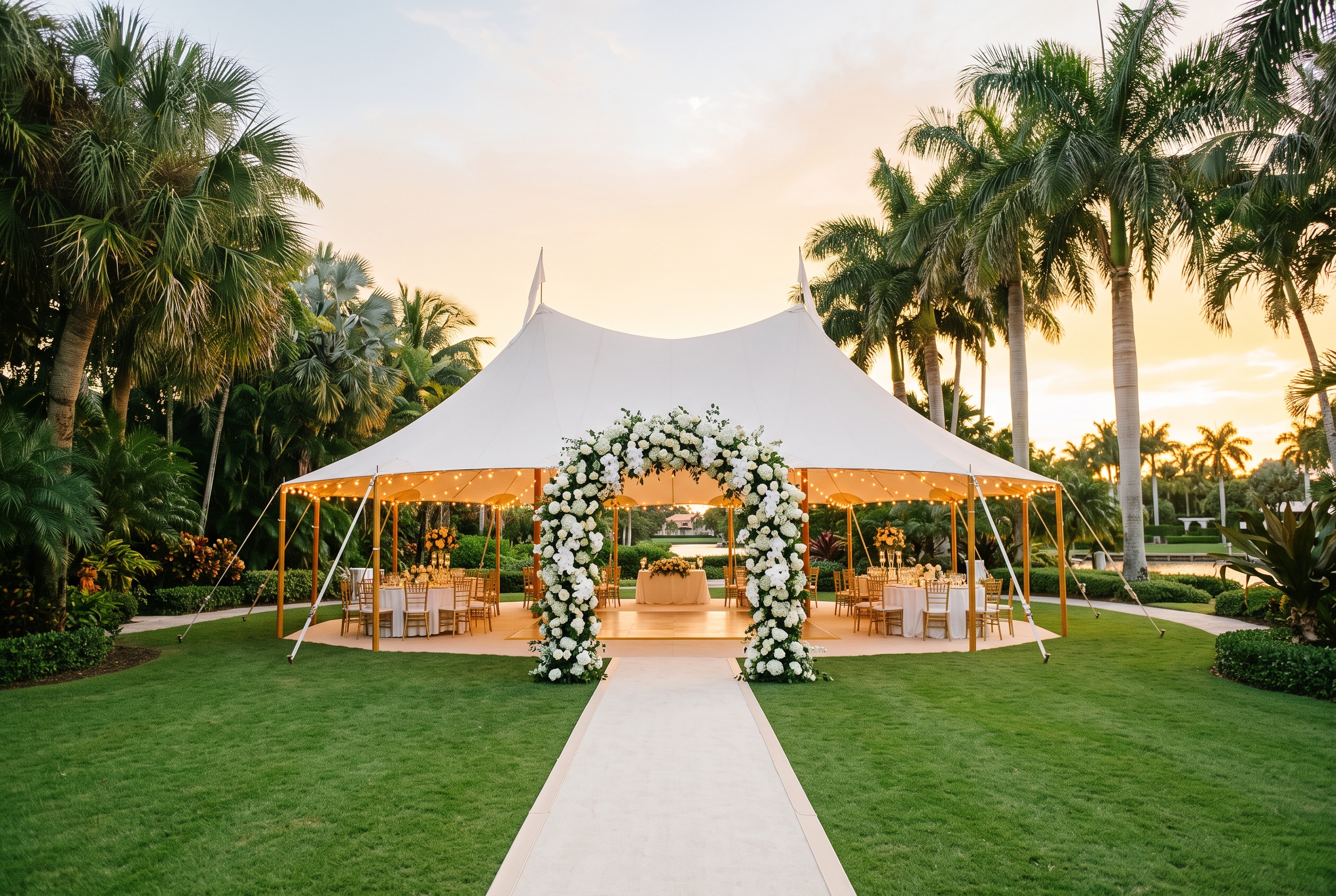
An outdoor wedding floor is built in layers from the ground up. A subfloor makes grass, sand or a slope firm and level, a dance floor sits on top of it, and a finished surface covers everywhere else guests walk, whether that's tent carpet, turf or an aisle runner. The ground you're working with decides how many of those layers you need.
Subfloors belong under a tent on a lawn, on sand or on any slope you can see. On a level pool deck, patio or paver courtyard you can skip one. On a firm, flat, dry lawn, a small party can get by with just an outdoor dance floor, as long as you can live with sinking chair legs and a dry forecast is on your side.
Dance floors go on grass only when they sit on something firm and level, either a subfloor or a rigid panel system built for outdoor use. Size one for roughly half your guests dancing at once.
Aisle runners on grass need weight and a firm path. A thin fabric runner bunches, lifts in the breeze and lets heels punch through. A carpet runner with bound edges lies flat and stays put. On sand, the aisle either goes bare or gets a firm base under the runner.
Here's how the ground under your tent or ceremony sorts the rest.
| Your ground | Subfloor | Dance floor | Aisle and walkways |
|---|---|---|---|
| Firm, level lawn | Best under a tent | On a subfloor or outdoor panels | Carpet runner, pinned |
| Soft, wet or sloped lawn | Yes, leveled | On the leveled subfloor | Carpet runner over a firm path |
| Beach sand | Yes, for any reception floor | On a base that spreads weight | Bare, or carpet over panels |
| Pavers, pool deck, concrete | Usually not | Panels laid directly | Carpet runner or turf |
How to Check Your Ground Before You Book
Checking your ground takes about an hour, and it answers most of the questions a tent company will ask. Walk the spots where the ceremony, the tent and the dance floor will go, with a tape measure and a long, straight board. You're looking for three things: whether the ground is level, whether it's firm and whether it stays wet.
To check level, lay the board across the lawn in a few directions and look for daylight under it. A drop of more than an inch or two across the tent's footprint is enough to rock tables and open gaps in a dance floor. On a real slope, measure how far the ground falls from one side of the tent to the other, because that number decides the subfloor.
Test firmness in the shoes the wedding party will wear. Chair legs work their way into turf over a long dinner, and heels go in right away. Inch for inch, a slim heel presses harder on the ground than a walking elephant's foot does, which is why a lawn that feels solid in sneakers turns into a trap in stilettos.
Wet ground is easiest to judge the morning after a heavy rain. Note the low spots where water stands, the path it takes as it drains and where the sprinkler heads are. A floor shouldn't sit on any of them.
Do You Need a Subfloor for a Tent Wedding?
Yes, if the tent sits on grass, sand or a slope and guests will dine or dance under it. No, if it sits on level pavers, concrete or a pool deck. A tent subfloor is a temporary floor built over the ground, and everything else sits on it: tables, the bar, the dance floor and the carpet. It keeps tables level, chairs from sinking and feet dry when an afternoon storm soaks the lawn.
Hard surfaces still deserve a look. Pool decks slope toward the pool and the drains, pavers lift and settle, and some sealed stone and deck coatings don't take kindly to tape. Once those spots are known, dance floor panels, carpet and turf can go straight down.
The budget middle ground is an outdoor dance floor on its own, laid on a firm, level, dry lawn. It costs far less than flooring the whole tent and suits a small, short party. You give up a good deal, though. Chairs sink, heels sink, the grass is damp by dark, and one storm the day before turns the dining area to mud.
Loose plywood sheets laid straight on the grass are the usual do-it-yourself tent floor. They rock, drift apart at the joints and leave raw edges to trip on.
Subflooring Products for a Wedding Tent
Four kinds of subflooring products turn up under wedding tents, and they differ most in whether they can take out a slope. Your tent or rental company supplies the subfloor, and the carpet that goes on top of it is ours. Ask them how much your ground drops and which system they'll use for it.
| Subfloor type | Best on | Levels a slope? | Effect on the lawn |
|---|---|---|---|
| Plywood on a leveled frame | Lawns with gentle grades | Yes, with shims or jacks | Blocks light; keep it short |
| Modular deck with adjustable legs | Slopes and uneven ground | Yes, the most | Shades the lawn, little contact |
| Interlocking plastic panels | Firm, level lawns and sand | No | Vented or clear types let light in |
| Ground-protection mats | Walkways and service paths | No | Spreads weight; varies by type |
Plywood on a leveled frame is the classic tent floor. The sheets are screwed to wood or metal framing, the framing is shimmed or jacked level, and carpet goes on top.
Modular decks with adjustable legs are the kind of system used for stages. Each panel stands on legs set to their own height, so the floor can sit many inches off the ground on the low side of a slope.
Interlocking plastic panels lock together right on the ground and go down fast. They follow the ground's shape, so they suit a lawn or firm sand that's already flat. Ground-protection mats are rigid panels that spread weight over walkways, service paths and cocktail areas, and they need a finished surface on top.
Leveling a Slope, and the Edges and Ramps That Come With It
On a slope, the floor stays flat while the ground falls away under it, so the low side of the tent stands higher off the lawn than the high side. That edge height is the number to ask for, because it decides how guests step on and off. A floor a couple of inches up needs beveled edges. One that stands half a foot or more needs steps and ramps, and a real drop along an edge needs a railing.
Put the main entrances on the high side, where the floor sits closest to the lawn and the ramps stay short.
Hold the edges to the numbers public buildings use. Under the ADA's accessibility standards, a change in level up to 1/4 inch can be a plain edge. Anything from 1/4 to 1/2 inch must be beveled, and anything higher needs a ramp no steeper than 1 inch of rise per foot. In other words, every inch of floor height at an entrance needs a foot of ramp, so a subfloor standing 6 inches off the lawn needs a 6-foot ramp for wheelchairs, strollers and anyone unsteady in heels.
The same standards want a carpet's exposed edge fastened down and trimmed along its whole length. That's why the tent carpet and runners we lay have bound or secured edges, never raw ones that curl.
What a Subfloor Does to Your Lawn
A subfloor protects the lawn from heels and chair legs, but it also shades the grass, traps heat and keeps water out. The National Park Service, which permits events on the lawns of the National Mall, bans plywood as a turf cover because it blocks nearly all the light grass needs. It also limits anything that blocks light, such as a tent or a stage, to two days in summer.
Our summers are hotter than Washington's, so plan the floor to go down as close to the wedding as your rental company can manage and come up the next morning. Where a floor has to stay down longer, interlocking panels with vented or clear tops let some light and air reach the grass.
Keeping the Floor Dry in a Storm
A raised subfloor keeps the carpet and your guests out of the water when a storm rolls through, as long as the water has somewhere to go. Keep the floor out of the lawn's low spots, and make sure the tent's roof and sidewalls shed rain away from the floor's edge. Leave the space under the floor open so water runs through it instead of pooling against it.
Can You Put a Dance Floor on Grass?
Yes, as long as the dance floor sits on something firm and level, like a subfloor or a rigid interlocking system made for outdoor use. Indoor-style panels laid straight on a lawn rock on the bumps and pull apart at the joints. They also sink under a crowd, and the grass under them stays wet all night.
Dance Floor Types That Work Outdoors
Most wedding dance floors are portable panels that lock together into any size. You'll see wood-look parquet, white or black gloss, checkerboard, vinyl-topped panels and light-up floors. Outdoors, the base and the top matter more than the look. Wood-topped panels need a subfloor under them, not damp grass, while interlocking outdoor tiles with vented backs are built to sit on a lawn or a deck.
Any hard, smooth top turns slick with evening dew, and in our humidity the dew comes early. Ask whoever sets up the floor to wipe it down before the first dance.
What Size Dance Floor Do You Need?
Plan on 40 to 50 percent of your guests dancing at once, with about 4 square feet each. That's the guideline in The Knot's dance floor sizing guide, which calls a 20 by 20 foot floor close to universal for 75 to 150 guests. A live band tends to pull more people up, so add 5 to 10 percent for one. A floor that's too big looks empty and keeps people in their seats, so if you're between two sizes, take the smaller.
| Guests | Dance floor |
|---|---|
| 50 | 12 x 12 feet |
| 75 | 12 x 15 feet |
| 100 | 15 x 15 feet |
| 150 | 18 x 18 feet |
| 200 | 21 x 21 feet |
Where the Dance Floor Meets the Carpet
The dance floor sits on the subfloor, and the tent carpet runs right up to its edges. That joint should be flush, or finished with a beveled trim, so nobody catches a toe on a lip. Put the dance floor near the band or DJ, clear of tent poles and away from the tent's low side. Leave a wide, straight path to it from the tables so guests aren't crossing carpet seams in the dark.
Aisle Runners for Outdoor Ceremonies
For a ceremony on grass, the runner that works is a carpet runner with bound edges, laid on a firm path and pinned down. That's the runner we cut and bind for weddings. Fabric, paper and plastic runners are made for smooth indoor aisles. On a lawn they wrinkle over the bumps, lift at the edges and tear where heels land.
You don't strictly need an aisle runner outdoors, but it earns its place on grass. It keeps hems and shoes clean, it shows the flower girl and ring bearer where to walk, and it covers the patchy spots in the lawn that would otherwise show up in every photo.
Why Thin Runners Fail on Grass
A thin runner has no weight and no stiffness, and a lawn gives it every chance to move. The first breeze lifts an unpinned edge. The processional pushes wrinkles ahead of it, and each heel drives a hole through the fabric into the soft ground. A carpet runner is heavy enough to stay flat and stiff enough to bridge small dips, and a heel lands on the pile instead of punching through it.
On a freshly mown, firm lawn, a carpet runner goes straight on the grass. Where the ground is soft or patchy, lay a path of plywood or flat panels first and put the runner over it, so heels have something solid under the pile.
Aisle Runner Width and Length
Measure the aisle from where the processional starts to the front of the ceremony. Add a few feet at each end so the runner starts before the first step and finishes under the arch. A 3-foot runner suits a narrow aisle, and 4 feet lets a couple or two attendants walk side by side. Leave some space between the runner and the chairs so guests don't step on its edges as they sit.
Most carpet comes in 12-foot-wide rolls, so a runner cut along the roll covers even a long garden aisle in one piece, with no seam across it for a heel to catch.
Holding a Runner Down on Grass, Pavers and Venue Floors
The surface under the runner decides how it's held down, and the edges matter most. A bound edge lies flat and can't fray into loose threads that catch a heel. On any stone or finished floor, test the tape on a hidden spot first.
| Surface | How to secure it | Watch for |
|---|---|---|
| Grass | Landscape pins every few feet, both edges | Sprinkler heads, dips, wet ground |
| Pavers or pool deck | Tested tape, or weights on delicate stone | Slope to drains, sealed surfaces |
| Indoor venue floor | Only tape the venue approves | Finish damage on wood or marble |
| Subfloor or deck | Taped along both edges | Joints between panels |
Unroll the runner as late as the schedule allows so it stays clean and nobody walks it first. Traditionally the ushers roll it down the aisle just before the processional. If it goes down early, rope off the aisle and seat guests from the outer ends of the rows.
Runner Colors, Including Red Carpet
White and ivory look the most bridal and show every blade of grass and every scuff, so they suit a clean surface and a last-minute unroll. Champagne, gray and soft neutrals forgive a lawn, and black hides almost everything. The same bound carpet runner in red makes the classic red carpet for a gala entrance or a grand arrival.
You can see the runners, runways and red carpets we've laid in our events gallery, and browse our carpet colors online before you choose. For color schemes and patterns across a whole event, our post on event flooring designs that set the mood has ideas.
Floors and Runners on the Beach
A beach ceremony can usually have a runner, but a beach reception floor needs a bigger permit and, for much of the year, has to be gone by sundown. Miami Beach shows how this works. The city's ceremony permit covers weddings of up to 150 guests for up to four hours. It lists a runner among the approved items, along with chairs, an arch or chuppah, up to five tables and up to three 10 by 10 pop-up tents.
Anything beyond that list, such as a reception next to the ceremony, needs a full special event permit. The city wants a ceremony application at least 14 days ahead.
Sea turtle season adds its own rules. Nesting season runs from March 1 in Broward and Palm Beach counties and from May 1 in Miami-Dade, through October 31. Under Miami Beach's turtle-protection conditions for permitted events, anything left on the sand overnight has to stand at least 3 feet clear of it, and a floor can't. On the sand, a wedding floor is a same-day floor.
Floors, runners and equipment come off the beach by sundown, supplies are staged off the sand, and any holes or ruts get filled and raked smooth each evening. For a sunset ceremony, plan on a quick teardown.
Sand is hard on a runner, too. Pins pull out of loose sand, the breeze off the water lifts the edges, and blowing sand buries the runner mid-ceremony. A heavy carpet runner on the firmer, damp sand near the water holds better than a fabric one on soft, dry sand.
On soft sand, interlocking panels laid under the runner give heels something to stand on, and they come up with everything else. Plenty of couples simply go barefoot down a raked, bare aisle.
Tent Carpet, Turf and Lounge Rugs
Everywhere guests walk that isn't the dance floor still needs a finished surface, and that's the layer we supply for weddings. We lay tent carpet over the subfloor, put down turf for cocktail areas and pool decks, and cut and bind carpet into rugs for lounges.
Carpet Over the Tent Floor
Carpet over a plywood subfloor hides the sheet joints, quiets footsteps and gives heels grip. For a tent, choose a low, dense pile in a fiber that handles damp air. Olefin (polypropylene) resists moisture and fading, and solution-dyed yarns, which get their color before the fiber is formed, hold that color in the sun.
A pad doesn't belong under tent carpet. Firm carpet laid right on the deck is easier on wheelchairs and heels, and the ADA's accessibility standards cap pile at 1/2 inch for that reason. Tent carpet goes down in 12-foot widths, seamed or taped, so plan the seams to run away from the main walkway and the dance floor edge. Darker colors hide the grass and soil guests carry in from the lawn.
Turf for Cocktail Hours and Pool Decks
Turf lays over pavers, concrete, pool decks or a subfloor with no digging, drains fast after a storm and looks like lawn where there isn't one. Turf installation is one of our services, alongside carpet binding. On pavers, the edges are held with tape tested on a hidden spot, or with the weight of planters and furniture where the stone is delicate.
In full sun, turf gets hot. Penn State's Center for Sports Surface Research puts synthetic turf at 35 to 55 F hotter than natural grass, hottest between noon and 3 pm, and watering only knocks the heat down for a short while. Keep turf under the tent or in shade, or save it for an evening cocktail hour. Laid over a real lawn, turf blocks light like any other cover, so put it down as late and take it up as early as you can.
Lounge Rugs
A lounge corner with sofas reads as a room once it has a rug under it. On a subfloor or deck, that rug should be as flat and secure as the rest of the floor. We cut carpet to the size of each lounge and bind the edges so they won't curl or fray, the same way we make custom area rugs for homes.
Planning Around South Florida's Rainy Season
From mid-May to mid-October, plan every outdoor floor for an afternoon storm. That's our rainy season, when most of the year's rain falls and thunderstorms build most afternoons. A raised subfloor keeps carpet dry while the lawn under it runs with water. Carpet laid straight on grass wicks the water up and stays wet into the evening, so in these months the full floor is worth more than it is in winter.
Keep the tent's sidewalls on hand. If a storm hits the morning of a lawn ceremony, the runner goes down on a firm path at the last moment. From November through April the ground is firmer and storms are rarer, which makes every layer of an outdoor floor easier.
How to Plan an Outdoor Wedding Floor, Step by Step
- Walk the site with your tent company and check level, soft spots, sprinkler heads and where water runs after rain.
- Fix the layout: aisle length, dance floor size, tables, bar, lounges and the paths to restrooms and parking.
- Book the tent, subfloor and dance floor. Ask how they'll level the ground, how high the low side will stand, where the ramps go, and when they install and remove.
- Book the finish layer. Send us the tent size, the dance floor's size and position and the aisle length, and we'll plan the carpet, runner and turf to fit.
- Turn the sprinklers off a day or two ahead so the ground firms up, and mark the heads.
- Install from the bottom up: subfloor, dance floor, carpet around it, turf, and the runner last.
- Take the floor up the morning after.
What We Handle, and What Your Rental Company Brings
At Don Bailey Flooring, we handle the flooring guests see and walk on at an outdoor wedding. That means aisle runners and red carpets cut to length with bound edges, tent carpet over the subfloor, turf for cocktail areas and pool decks, and bound rugs for lounges. The tent, the subfloor under it and the dance floor usually come from your tent and rental company, and we plan our carpet, runners and turf around their layout.
Our event flooring service is simple. You pick the flooring, tell us where it's going, and we take it from concept to execution. We've handled flooring at some of South Florida's biggest events, including Super Bowl LIV, the Miami International Boat Show, the Formula 1 Miami Grand Prix and Art Basel. We're a family-owned South Florida business with four showrooms, so you can see carpet colors in person before you choose.
If you're planning floors for a corporate event, a trade show or an indoor gala, our guide to choosing flooring for every kind of occasion covers those.
Outdoor Wedding Flooring FAQ
What Can I Use Instead of an Aisle Runner?
A bare aisle lined with petals, lanterns or potted flowers works on a mown, firm lawn. A row of bound rugs laid end to end gives a softer, collected look, and turf makes a green aisle across a paver courtyard or pool deck. Whatever you pick, check the path for dips and sprinkler heads, because the processional walks it in formal shoes.
Do You Need a Dance Floor for an Outdoor Wedding?
No, not on a level patio, pool deck or paver courtyard, where guests can dance on the hard surface. On grass or sand you do. A crowd dancing after dinner churns a lawn into ruts and turns sand into a workout, and a dance floor gives everyone a flat, safe surface.
Does Event Carpet Under a Tent Need to Be Fire-Rated?
Yes, and every carpet and rug sold in the US already has to pass federal flammability testing, so the carpet we lay under a tent meets that standard too. Some venues and fire marshals ask for paperwork on tented events. Tell us before we order, and we'll get the documentation for the carpet you choose.
How Far Ahead Should We Book Wedding Flooring?
Book as soon as your layout is set, because the carpet, runner and turf are cut to your tent, dance floor and aisle sizes. Lock in the tent and subfloor first, since their size and height decide ours.
How Much Does Tent Flooring Cost?
Tent flooring is priced by the square foot, and the ground sets the rate. A level deck or lawn needs the least work, and a slope that has to be built up costs the most, with delivery, installation and next-day removal on top. Your rental company quotes the subfloor and dance floor, and we price the carpet, runners and turf from your measurements at no charge.
Plan Your Wedding Floor With Us
Once you know your tent size, your dance floor and the length of your aisle, the rest of the floor is ours to plan. Request a free estimate with your date, your venue and the ground you're working with, and we'll put together the runners, tent carpet and turf that fit your day.


